If you’ve watched a netball game recently and noticed players swapping on and off the court mid-quarter without any stoppage, you’ve seen a rolling substitution in action. It’s one of the biggest rule changes in netball in years, and it applies at every level from local Saturday competition right up to Super Netball.
Here’s how rolling subs work, what the rules are, and what it means for players, coaches, and parents on the sideline.
What Is a Rolling Substitution?
A rolling substitution is when an off-court player swaps with an on-court player during live play. The game doesn’t stop. The swap happens in real time through a designated substitution zone near the team bench.
Before this rule, substitutions could only happen at quarter breaks, half-time, or during stoppages for injury. That meant coaches had limited chances to rotate players and manage fatigue. Rolling subs changed that completely.
When Did the Rule Change?
World Netball introduced rolling substitutions as part of the updated Rules of Netball released in December 2023. In Australia, Netball Australia adopted the rule from 1 January 2024 across all Netball Australia-affiliated competitions, including state leagues, associations, and local Saturday competitions.
Manningham Netball Association (where Warrandyte Netball Club competes) adopted the rule from Round 1 of the 2024 season.
How Do Rolling Subs Work?
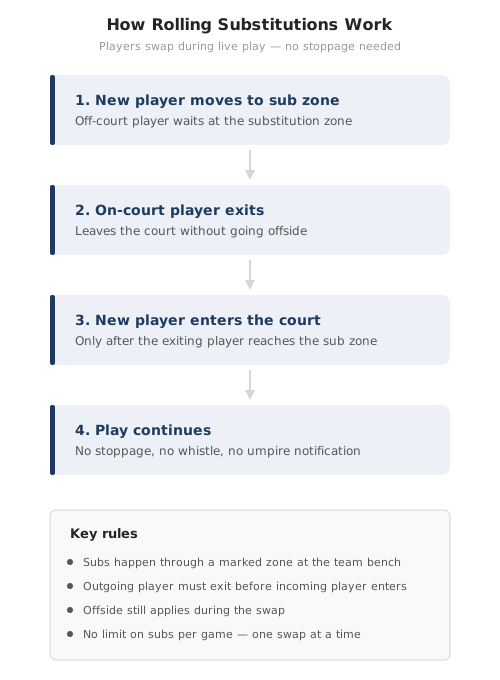
The rules are straightforward, but there are some important details:
The Substitution Zone
Each team has a designated substitution area marked on the ground at each end of the team bench. On indoor courts, this is alongside the score bench. On outdoor courts, it’s near the scorers in the middle of the court. All rolling subs must happen through this zone.
One at a Time
Rolling subs are a single swap: one player comes off, one player goes on. The incoming player is already wearing a position bib from a second set and must tag hands with the outgoing player inside the substitution zone before entering the court. You can’t send two players on at once. Only one person from each team should be in the substitution zone at any time.
No Stoppage, No Notification
The umpire does not need to be told. Time is not held. The game continues while the swap happens. This is the key difference from the old system. There’s no waiting for a break in play.
No Limit
There’s no cap on how many rolling substitutions a team can make during a game. A coach could rotate the same player on and off multiple times in a single quarter if needed.
Offside Still Applies
This is the rule that catches people out. A player entering or leaving the court during a rolling sub must observe the offside rule. That means the incoming player must enter the court in an area allowed for their position, and the outgoing player must leave from an area their position is allowed in.
Example: A Goal Shooter (GS) can only be in the attacking goal third. If the substitution zone is at the centre of the court, the incoming GS must move directly to the attacking third without entering the centre third, or the umpire will call offside.
Position Changes
A rolling substitution is a like-for-like player swap — the incoming player must take the same position as the outgoing player. If you want to change positions (for example, moving your WA to GA), players must be substituted off and back on in different positions, or the change can be made at a quarter break or during a stoppage for injury.
Rolling Subs vs Tactical Substitutions
The 2024 rule changes also introduced a separate concept called a tactical substitution. They sound similar but work differently:
| Feature | Rolling Substitution | Tactical Substitution |
|---|---|---|
| When | Any time during play | Immediately after a goal is scored |
| Stoppage | No, play continues | Yes, umpire holds time |
| How many | One swap at a time | Any number of swaps and position changes |
| Offside | Yes, must be observed | No, offside doesn’t apply during stoppage |
| Position changes | No, like-for-like only | Yes, any changes allowed |
| Notification | None needed | On-court player requests from umpire |
Note: Competitions that use rolling substitutions generally don’t also use the tactical change rule. It’s one or the other. In Manningham Netball Association, rolling substitutions are used.
Why Were Rolling Subs Introduced?
The change was driven by several factors:
- Player welfare: More frequent rotation means players get rest during quarters, reducing fatigue and injury risk, especially for junior players and in hot conditions
- More court time for everyone: Coaches can give more players game time without waiting for quarter breaks, which is particularly valuable in junior netball where development and inclusion matter
- Faster, more dynamic games: Fresh legs on court keep the pace up and make games more exciting to watch
- Alignment with elite netball: Super Netball already used rolling subs, so grassroots competitions now mirror the professional game
What It Means for Junior Netball
Rolling subs have been a positive change for junior netball. Coaches can manage playing time more flexibly. A player having a tough quarter can be rested and brought back on without waiting for the break. It also means larger squads can work, because there are more opportunities to rotate everyone through.
For parents, the main thing to know is that your child might come on and off the court during a quarter. That’s normal and doesn’t mean anything is wrong. It’s just the coach managing the team.
Tip for parents: If you’re scoring or timing, you don’t need to track rolling substitutions. The umpire doesn’t stop play for them. Just keep an eye on the position bibs to follow who’s on court.
Quick Reference
- Rolling subs can happen at any time during play
- One player on, one player off, through the designated zone
- No limit on the number of subs per game
- No need to notify the umpire
- Offside rules still apply during the swap
- Like-for-like only — position changes require subbing players off and on, or a quarter break
Learn More
Understanding substitutions is just one part of the game. Our Netball Guide covers everything from positions to what age to start.
Ready to get on court? See our teams or register now for the season.