Whether you’re a player, parent, or spectator, understanding the seven positions is the fastest way to make sense of a netball game. This guide covers every position, where they can go on court, and what skills and attributes suit each role.
The rules governing positions are set by World Netball.
The Court at a Glance
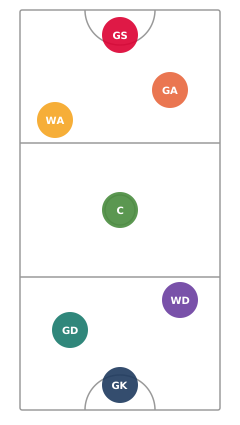
The court is divided into three equal thirds, with a goal circle at each end. Every player wears a position bib that restricts where they can go — step outside your allowed area and the umpire calls offside.
Attacking positions (GS, GA, WA) operate in the top two thirds. The Centre covers all three thirds but cannot enter either goal circle. Defensive positions (WD, GD, GK) operate in the bottom two thirds.
Only two positions can score: Goal Shooter (GS) and Goal Attack (GA), and only from inside the goal circle. Each position is colour-coded in the detailed breakdowns below.
The Seven Positions
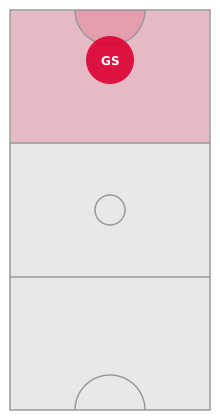
Goal Shooter (GS)
Bib: GS
Allowed on court: Attacking goal third, including the goal circle
Primary role: Score goals
The Goal Shooter is the primary scorer. They operate in the attacking goal third and spend most of their time in or near the goal circle, working to get free for a shot. A good GS has accurate shooting from anywhere in the circle, holds strong position under the post, and times their movement to receive the ball in space.
GS is often one of the taller players on the team, but height isn’t everything. Balance, confidence under pressure, and the ability to shoot consistently are what count.
Good fit for: Players who are accurate, composed under pressure, and comfortable being the focal point of the attack.
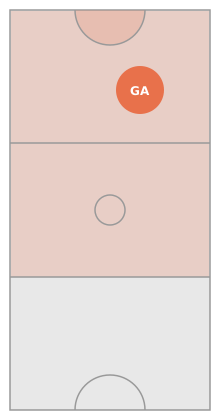
Goal Attack (GA)
Bib: GA
Allowed on court: Attacking goal third (including goal circle) and centre third
Primary role: Score goals and create attacking opportunities
The Goal Attack is the most versatile attacking position. GA can shoot (like GS) but also operates across the centre third, linking the midcourt feeders with the shooting circle. A strong GA reads the play, drives into the circle at the right time, and can shoot accurately from a range of angles, not just under the post.
GA often covers more ground than any other attacker, making fitness and agility important alongside shooting ability.
Good fit for: Energetic, versatile players who can both shoot and create. Often the player who makes things happen in attack.
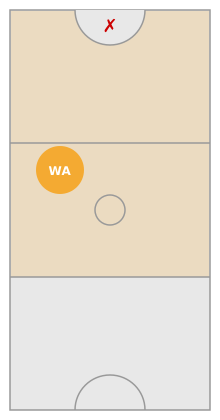
Wing Attack (WA)
Bib: WA
Allowed on court: Centre third and attacking goal third (but NOT the goal circle)
Primary role: Feed the ball into the shooters
The Wing Attack is the primary feeder, the player who delivers the ball into the goal circle for GS and GA to shoot. WA needs excellent passing skills, good court vision, and the ability to read what the shooters need before they even call for the ball. A perfectly weighted pass into the circle is one of the most satisfying plays in netball.
WA cannot enter the goal circle or the defensive third, so their value comes from movement, timing, and precision passing rather than shooting.
Good fit for: Smart, quick players with strong passing skills who enjoy setting up goals rather than scoring them.
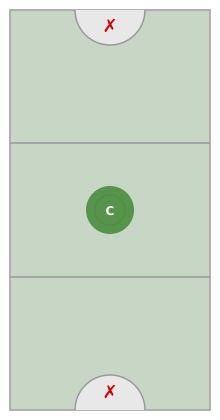
Centre (C)
Bib: C
Allowed on court: All three thirds (but NOT either goal circle)
Primary role: Link attack and defence, control the flow of the game
The Centre has the most freedom on court, covering all three thirds. It’s the only position that can move through the entire length of the court (minus the two goal circles). Centre takes every centre pass (the restart after each goal) and is responsible for transitioning the ball from defence to attack.
This is the engine room of the team. A good Centre has exceptional fitness (they cover the most distance of any player), reads the game in both directions, and makes smart decisions under pressure. They need to defend when the opposition has the ball and attack when their team wins it back.
Good fit for: Fit, high-energy players who love being involved in everything. Often the player with the best game sense on the team.
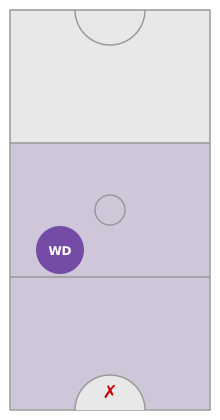
Wing Defence (WD)
Bib: WD
Allowed on court: Centre third and defensive goal third (but NOT the goal circle)
Primary role: Shut down the opposition’s Wing Attack
Wing Defence mirrors the opposition’s WA, working to intercept passes, disrupt feeding into the circle, and force turnovers. WD is the first line of defence in the midcourt. If they do their job well, the ball never reaches the opposition’s shooters.
A great WD reads the play early, anticipates passes, and has quick feet to stay with their opponent. They also play a key role in transitioning the ball forward after a turnover, linking with their own Centre and WA.
Good fit for: Tenacious, quick players who enjoy the challenge of shutting down an opponent. The position for players who love to compete one-on-one.
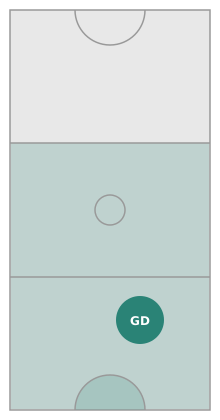
Goal Defence (GD)
Bib: GD
Allowed on court: Defensive goal third (including goal circle) and centre third
Primary role: Defend against the opposition’s Goal Attack
Goal Defence pairs with the opposition’s GA, working to limit their impact in and around the circle. Like GA is the most versatile attacker, GD is the most versatile defender. They need to defend in the circle, contest for rebounds after missed shots, and also help in the centre third.
GD works closely with GK as a defensive partnership. Communication between the two is critical. They coordinate who pressures the ball and who covers space, especially inside the goal circle.
Good fit for: Athletic, competitive players who can read the game and adapt. Needs to be comfortable defending in the circle and out in open play.
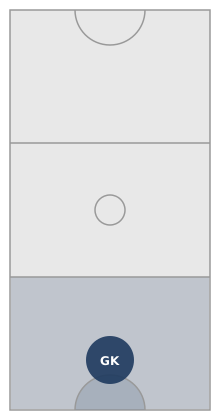
Goal Keeper (GK)
Bib: GK
Allowed on court: Defensive goal third, including the goal circle
Primary role: Defend the goal and prevent the opposition from scoring
The Goal Keeper is the last line of defence. They mark the opposition’s GS, working to block shots, intercept passes into the circle, and win rebounds. A good GK positions themselves between the shooter and the post, uses their reach to pressure shots, and turns to attack the rebound the moment a shot is taken.
GK is often one of the tallest players on the team, but positioning and timing are just as important as height. The best goal keepers are patient. They wait for the right moment to strike rather than lunging at every ball.
Good fit for: Tall, patient players who enjoy the physical contest of one-on-one defending. Needs composure and explosive jumping ability.
How Positions Work Together
Netball is a game of partnerships and chains. Understanding how positions connect helps make sense of the game:
- The shooting pair (GS + GA): Work together inside the circle to create space and share the scoring load
- The feeding chain (C → WA → shooters): Centre wins the ball or takes the centre pass, feeds to WA, who delivers into the circle
- The defensive pair (GK + GD): Coordinate inside the circle to pressure shooters and contest rebounds
- The transition (GK/GD → WD → C): After a turnover, defence gets the ball out to midcourt and up the other end
Every goal requires the ball to pass through multiple pairs of hands. That’s why netball is such a strong team sport. No single player can dominate. Everyone has a role, and the team that connects best usually wins.
Which Position Is Right for You?
There’s no single “best” position. Every role is essential. At junior level especially, players often try several positions before finding where they fit best. Here are some general guidelines:
| If you’re… | Consider… |
|---|---|
| Tall with good hands | GS or GK — the shooting and defending end |
| Fast and love running | C or WA — the midcourt engine room |
| Competitive and love one-on-one contests | GD or WD — the defensive specialists |
| Versatile and energetic | GA — the position that does a bit of everything |
| A smart passer who reads the game well | WA or C — the playmakers |
At Warrandyte Netball Club, our coaches help players find the position that suits their strengths. Many players start in one position and grow into another as they develop. That’s all part of the journey.
Start Playing
Understanding positions is the first step. The best way to learn is to get on court and try them out. Warrandyte Netball Club offers programs for all ages and experience levels:
- Woolworths NetSetGO introduces positions in a fun, low-pressure environment from age 5
- Our junior teams develop positional skills through competition from 9 and Under
- New to netball? See our guide to girls sport in Warrandyte or find out why netball is a great choice
Ready to give it a go? Visit our registrations page or get in touch.