Every netball game has two umpires, one controlling each half of the court. They’re responsible for enforcing the rules, keeping the game safe, and making sure play flows fairly. If you’ve ever wondered what the whistle blasts and hand signals mean, or you’re thinking about becoming an umpire yourself, this guide covers the essentials.
What Do Umpires Do?
Each umpire controls one end of the court, from the goal line to the far transverse (third) line. Their responsibilities include:
- Starting and stopping play with the whistle
- Calling infringements (stepping, contact, obstruction, offside, and others)
- Awarding free passes and penalty passes
- Signalling whether a goal has been scored
- Managing player behaviour, including issuing warnings and suspensions
- Working with the scorer and timekeeper
The two umpires work together but make independent decisions in their own half. If the ball crosses into the other umpire’s half during an infringement, the controlling umpire still makes the call based on where the infringement occurred.
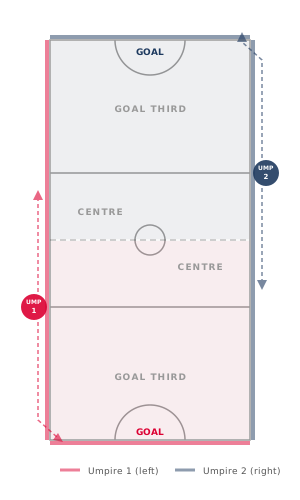
Areas of control
The court is split horizontally through the centre circle. Each umpire controls one half of the court and is responsible for all decisions in that half.
Each umpire controls:
- All infringement calls (stepping, contact, obstruction, offside) in their half
- All throw-ins along their entire sideline
- The goal line at their end of the court
- Whether a goal is scored at their end
Movement: Umpires stay just ahead of the ball, moving along their sideline. When the ball enters the goal third, they cut the corner to position themselves near the goal line for the best view of shooting and circle play.
In the centre third, both umpires share visibility. If you’re unsure which umpire made a call, watch which sideline they’re standing on — that’s their half.
Common Umpire Signals
Umpires use hand signals alongside the whistle so players, coaches, and spectators can see what’s been called. Here are the signals you’ll see most often:
Infringement Signals
| Call | Signal | What It Means |
|---|---|---|
| Stepping (footwork) | Rotating hands around each other | The player moved illegally with the ball. See footwork rules. |
| Held ball | Arms raised, palms open, moving up and down | The player held the ball for more than three seconds |
| Offside | Arm raised, hand pointing towards the area the player entered | A player entered a court area they’re not allowed in |
| Contact | Hands on body where contact occurred | A player made illegal contact with an opponent |
| Obstruction | Arms outstretched in front of body | A defender was too close (under 0.9m) with arms raised |
| Over a third | Arm sweeping across body horizontally | The ball was thrown over a complete third without being touched |
| Short pass | Hands held close together | Not enough distance between the passer and receiver |
| Breaking | Arms crossed at chest then separated | A player moved from their position before the centre pass whistle |
Other Signals
| Call | Signal | What It Means |
|---|---|---|
| Goal scored | One arm raised straight up | The shot went through the ring and counts |
| Goal not scored | Arms crossed above head | The shot did not count (player outside circle, wrong position, etc.) |
| Direction of pass | Arm pointing in the direction of the team who gets the ball | Indicates which team takes the free pass or throw-in |
| Advantage | Arm extended, palm open, in direction of play | The umpire saw an infringement but let play continue because stopping would disadvantage the non-offending team |
| Time | Hands forming a T shape | Time is being held (injury, substitution, or end of quarter) |
Tip for spectators: Watch the umpire’s arm after the whistle. It always points in the direction of the team who gets the ball next.
Penalty Passes vs Free Passes
Not all infringements result in the same penalty. Understanding the difference helps you follow what’s happening:
- Free pass: Awarded for stepping, offside, held ball, over a third, short pass, and breaking. The opposition takes the ball and all players can defend normally.
- Penalty pass (or penalty shot): Awarded for contact, obstruction, and intimidation. The offending player must stand beside the person they fouled and out of play until the ball is released. If the penalty is inside the goal circle, the attacking team can choose to take a shot.
For a full breakdown of all the rules, see our netball rules guide or the official World Netball rules.
Becoming an Umpire
Umpiring is a great way to stay involved in netball, build confidence, and give back to the sport. Many umpires start young and go on to officiate at representative and state level.
When Can You Start?
At Warrandyte Netball Club, players can begin umpiring from the 15 and Under age group. Most associations allow junior umpires from around age 12 to 14, depending on their experience and maturity. Younger players often start by scoring or timing games before stepping up to umpiring.
The Umpiring Pathway
Netball Victoria runs a structured umpiring pathway with nationally recognised badge levels:
- Foundation Umpire Course: An online course covering the basics. Topics include the role of the umpire, communication, game management, and rules. This is the starting point for all new umpires.
- Rules of Netball Exam: An online exam required before you can be assessed for a badge. The pass mark depends on the badge level: 70% for C Badge, 80% for B Badge, and 90% for AA Badge.
- National C Badge: The first practical badge. You’re assessed during a game by a qualified tester who evaluates your positioning, whistle use, signals, and rule application.
- National B Badge: The next step up, assessed at a higher standard of game management and consistency.
- National A Badge: Advanced level, typically required for state-level and representative netball.
- National AA Badge (All Australia): The highest national accreditation. Requires an A Badge first.
You don’t have to progress through every level. Many club and association umpires are happy at C Badge level, which is all that’s needed for Saturday competition.
What Makes a Good Umpire?
You don’t need to be the loudest person on the court or know every rule perfectly on day one. The best umpires share a few common qualities:
- Consistency: Calling the same infringement the same way every time matters more than being strict or lenient
- Positioning: Being in the right spot to see the play is half the job
- Confidence: Making a decision and committing to it, even if it’s unpopular
- Communication: Talking to players calmly and clearly, especially younger ones who are still learning
- Composure: Staying calm when coaches or spectators disagree with a call
Learn More
Umpiring goes hand in hand with understanding the rules and positions. Our Netball Guide covers all seven positions, the key rules, and rolling substitutions.
Interested in umpiring at Warrandyte? Get in touch and we’ll connect you with our umpiring coordinator.