Netball rules can seem confusing when you first watch a game. Whistles blowing, players freezing on the spot, umpires calling things you don’t quite catch. But the basics are simpler than they look, and once you understand a handful of key rules, the whole game makes sense.
This guide covers the rules that matter most: the ones umpires call every game and the ones new players learn first.
The rules of netball are set by World Netball and administered in Australia by Netball Australia.
The Basics
The Court and Teams
Each team has seven players on court. The court is divided into three equal sections called thirds, with a goal circle (semi-circle) at each end. Every player wears a position bib that determines where they can go. Step outside your allowed area and the umpire calls offside. For a full breakdown, see our positions guide.
Scoring
Only two positions can score: Goal Shooter (GS) and Goal Attack (GA). They must shoot from inside the goal circle. Each goal is worth one point. The team with the most goals at the end of the game wins.
Game Length
A standard game has four quarters. The length of each quarter depends on the age group and competition:
| Level | Quarter Length | Total Game Time |
|---|---|---|
| 9, 11, 13, 15 and Under | 10 minutes | 40 minutes |
| 17 and Under | 10 or 12 minutes | 40 or 48 minutes |
| 21 and Under / Open | 12 minutes | 48 minutes |
Note: Quarter lengths may vary between competitions. The times above are typical for Saturday association netball in Victoria.
Starting Play: The Centre Pass
After each goal and at the start of each quarter, play restarts with a centre pass. The Centre (C) stands in the centre circle with one foot in the circle, and must pass the ball within three seconds of the umpire’s whistle. The ball must be received in the centre third before it can be played into a goal third.
Centre passes alternate between teams, regardless of who scored.
The Key Rules
Footwork (Stepping)
This is the rule new players learn first. When you catch the ball:
- The first foot to land becomes your grounded foot (or pivot foot)
- You can step with your other foot in any direction as many times as you like
- But once you lift your grounded foot, you must pass or shoot before it touches the ground again
- You cannot hop, slide, or drag your grounded foot
If you land on both feet at the same time, you can choose either foot as the pivot. But once you lift one, the other becomes grounded and the same rules apply.
Three-Second Rule (Held Ball)
Once you catch the ball, you have three seconds to pass it or shoot. If you hold it longer, the umpire calls “held ball” and the opposition gets a free pass. Three seconds sounds short, but it’s enough time to pivot, look, and make a decision if you’re thinking before you catch, not after.
Offside
Every position has specific areas of the court they’re allowed in. If a player enters an area they’re not allowed in, even with just one foot, the umpire calls offside and the opposition gets a free pass.
The most common offside calls happen when:
- A Wing Attack (WA) runs into the goal circle
- A Centre (C) steps into a goal circle
- A Goal Shooter (GS) drifts into the centre third
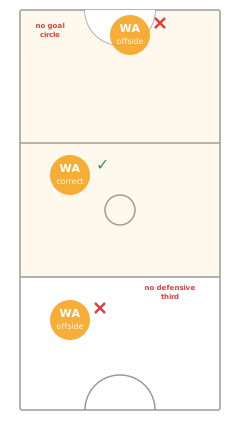
This example shows Wing Attack (WA), who is allowed in the attacking third and centre third but not the goal circle or defensive third. The shaded area shows where WA can go.
The two red WA markers show common offside errors — stepping into the goal circle to be closer to the shooters, or drifting back into the defensive third.
Every position has different allowed areas. Even one foot over the line is offside. For the full breakdown of where each position can go, see our positions guide.
Penalty: Free pass to the other team, taken from where the offside occurred.
Contact
Netball is a non-contact sport, though that doesn’t mean no contact ever happens. The rule is that you cannot contact an opponent in a way that interferes with their play. Bumping, pushing, charging into a player, or using your body to block them is not allowed.
When the umpire calls contact, the offending player must stand beside the person they contacted and out of play until the ball is released. This is called a penalty pass (or penalty shot if it happens in the goal circle).
Obstruction
When defending a player who has the ball, you must stand at least 0.9 metres (3 feet) away with arms extended. This distance is measured from the landing foot of the player with the ball to the nearer foot of the defender.
You can stand closer than 0.9 metres if your arms are down by your sides, but the moment you raise your arms to defend, you need that distance. If you’re too close with arms up, the umpire calls obstruction and the same penalty pass rules apply.
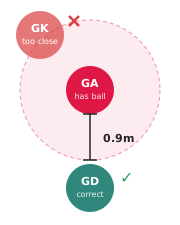
The dashed red zone shows the 0.9m exclusion area around the player with the ball. The defender (GD) is correctly positioned outside this zone. The other defender (GK) is too close — this would be called obstruction.
Penalty: Penalty pass, or penalty pass and shot if inside the goal circle. The offending defender must stand out of play beside the player they obstructed until the ball is released.
Tip: Get your distance right first, then extend your arms. It is better to stand at the right distance and lean in than to rush in and give away a penalty. Watch for the 0.9m distance from your nearer foot to the landing foot of the player with the ball.
Over a Third
The ball cannot be thrown over a complete third without being touched by a player in that third. For example, a pass from the defensive third cannot fly over the entire centre third and land in the attacking third. Someone in the centre third must touch it on the way through.
This rule keeps the game flowing through all areas of the court and ensures every position group is involved.
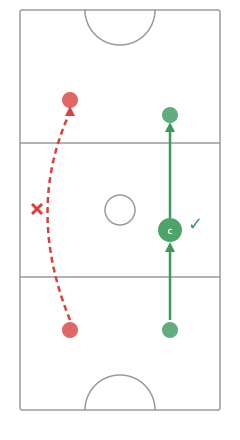
The diagram shows both an illegal and legal pass. On the left, the ball flies directly from the defensive third to the attacking third without being touched in the centre third — this is over a third and results in a free pass to the other team.
On the right, the ball is passed to a player in the centre third (the Centre) who then passes it forward into the attacking third. This is the correct way to move the ball up the court.
This rule keeps all seven positions involved and prevents teams from simply launching long passes over the midcourt.
Short Pass
There must be enough distance in the pass that a defender could genuinely attempt to deflect or intercept the ball. In practice, this means you can’t hand the ball to a teammate. There needs to be visible distance in the pass.
Throw-Ins
When the ball goes out of court, the team that didn’t touch it last takes a throw-in from behind the line where the ball went out. The player taking the throw-in must:
- Stand with their foot up to but not on the line (the line is part of the court)
- Pass the ball within three seconds
- Not step onto the court while throwing
Penalties Explained
Not all infringements are equal. Here’s the difference between the two main types:
Penalty pass (or shot)
Given for: Contact, obstruction, intimidation
- Ball goes to the other team
- Offending player stands out of play beside the fouled player
- Cannot move until the ball is released
- If in the goal circle, the attacking team can choose to shoot
Free pass
Given for: Stepping, offside, held ball, over a third, short pass, breaking
- Ball goes to the other team
- All players can move and defend normally
- No player stands out of play
- Cannot shoot directly from a free pass
The key difference: a penalty pass removes the offending defender from play until the ball is released, giving the attacking team a numerical advantage.
Advantage
Sometimes an umpire will see an infringement but choose not to blow the whistle. This is the advantage rule — if stopping play would disadvantage the team that didn’t break the rules, the umpire lets play continue. You’ll see the umpire signal this by extending one arm with an open palm in the direction of play.
Advantage is most commonly applied when the non-offending team already has the ball and is in a strong position. If no advantage exists, the umpire will blow for the infringement as normal.
Recent Rule Changes
Rolling substitutions were introduced as part of the 2024 Rules of Netball. See our rolling substitutions guide for details.
The current Rules of Netball (2024 edition) introduced several changes that apply to all Australian competitions:
- Rolling substitutions: players can swap on and off during live play
- Advantage rule updated: umpires can let play continue if stopping would disadvantage the non-offending team
- Centre pass appeals: teams can query which team should take the centre pass, but only before it’s taken
- Contact rule clarified: greater emphasis on player safety and managing physical play
Learn More
Rules make more sense once you see them in action. Our Netball Guide covers positions, substitutions, and getting started.
The best way to learn is to play. Warrandyte Netball Club has programs from Woolworths NetSetGO (age 5) right through to senior competition. Visit our registrations page to join.